Watching breasts.
Spent all of 2003 watching breasts new breasts firm breasts slack breasts non-existent breasts. I formed bodies from breast components, they were my Archimedean solids, one for the shoulder, elbow, ear-lobe, cheek, nostril and ball of foot. They became breasts and breasts became them. I was an architect, in best modern taste, obsessed with curves. Each container I wished to smooth of burrs and round, mould and encompass in human constant y=sinxes.
The ratio of a river’s length to it’s distance straight (as the crow flies) from source to mouth is defined by π, with modifications based on the hardness of the environment through which it runs. From mouth to vagina via the skin is surely ruled by the same calculations. If you could take a route straight down the esophagus, with a cutting through the gut – no detours, no taking a racing line down the small and large intestines but burning straight through with some burning beak - it would be much quicker.
Π and Sine is what I was after all along. I thought it was the roundness I was looking for, a depression, a dimple a press on skin relates to the amount of vitamin C you have been taking in recently? When, as a smoker, you go to the dentist, hey find it difficult to make you gums bleed - they have to push and scrape the probes vigorously to confirm that you are starving your mouth of oxygen. But it was the intrinsic inhumanness of curves.
Sitting in the conservatory of a pleasant villa in northern Italy - LIE, seaside cottage while the wind howled - LIE, the wind was audible periodically and he was in a suburb of a large post-industrial conurbation - BETTER.
Showing posts with label medicine. Show all posts
Showing posts with label medicine. Show all posts
Monday, 28 April 2008

Sunday, 2 March 2008
The Vulture
Not even the strongest generic pharmaceutical gap-filling cement could have kept his torso from the armpits up from remaining detached after thirty-five hours in surgery; that lump of metal, the incidental shell, hurled at forty-five degrees away from where the party was really at, had a party of its own. Sparing him the usual indignity, Jim’s bowels emptied up through a gap near where his left lung, gripped plaintive and instantaneously by the shoulders and head, might otherwise have been, had fate had it differently. Fate’s a funny thing; were Dr Rudolph not in that particular village at that particular time, surgery would most likely never have been considered an option. Circumstance (secular fate), however, had it that Dr Rudolph was in the boudoir of some local yokel whose wife was in the throes of “stress-induced anal distension”, as diagnosed. Trepanning and Hippocratic semen were intrinsic to the cure (notes on that case are smudged at best and cogent at worst; besides, that’s a tangent, and reports such as this will be tainted with nothing of the sort).
Jim was in a horrendous state when the nearest Fraulein reached his sodden dying patch of ground; it couldn’t have come as much of a surprise to those present at any point in the affair had they been told that fragments of bone and other bodily shrapnel had been flung as far even as the battlefield. Nobody was in any position, however, to tell them anything of the sort, or otherwise.
Saturday, 4 August 2007
Two Thoughts
Digital Piracy
I had no qualms present as I thieved Sunset Blvd. and The Maltese Falcon from under the dead-eyes of it's starving creators via a loose swarm of like-minded buccaneers. There was not an inch of conscience involved. My eyes continued their involuntary act of descending a steep slope of snow, with a barely controlled flourish. Either for the sheer thrill of the ride and/or to bypass tedious scree, I enjoyed the hell out of it.
I was a new modern man with his fingers on the keys not giving a damn or a penny to/for the third generation black-suiters who wanted my ill-earned hard cash for what is, undeniably, old Bogart. Of course I had a dog by the name which was put down for mauling toddlers, or so I assumed from the euphemism my mother used. Whatever happened to collective culture anyway, it is as guarded as a dictator's tomb?
Hysterical Paroxysm
On a related note there I was treating her for the nervous ailment that had troubled her all these dark months since her husband put to sea, and suddenly I found the equipment all covered in a tepid sort of semolina. 'Aha! by Jehova and all The Saints' I thought out loud, stowing the vibratode in it's hygienic red leather lined beech box, I've heard of this but never seen the like; 'too right' said the wife. Nowadays you can get them in the Argos catalogue.
- "Tyranno" 1918
I had no qualms present as I thieved Sunset Blvd. and The Maltese Falcon from under the dead-eyes of it's starving creators via a loose swarm of like-minded buccaneers. There was not an inch of conscience involved. My eyes continued their involuntary act of descending a steep slope of snow, with a barely controlled flourish. Either for the sheer thrill of the ride and/or to bypass tedious scree, I enjoyed the hell out of it.
I was a new modern man with his fingers on the keys not giving a damn or a penny to/for the third generation black-suiters who wanted my ill-earned hard cash for what is, undeniably, old Bogart. Of course I had a dog by the name which was put down for mauling toddlers, or so I assumed from the euphemism my mother used. Whatever happened to collective culture anyway, it is as guarded as a dictator's tomb?
Hysterical Paroxysm
On a related note there I was treating her for the nervous ailment that had troubled her all these dark months since her husband put to sea, and suddenly I found the equipment all covered in a tepid sort of semolina. 'Aha! by Jehova and all The Saints' I thought out loud, stowing the vibratode in it's hygienic red leather lined beech box, I've heard of this but never seen the like; 'too right' said the wife. Nowadays you can get them in the Argos catalogue.
- "Tyranno" 1918
Tuesday, 15 May 2007
Mama Sita
In the same vein as my previous post, this one nonetheless has a distinguishing feature; I remember a little about its genesis. I asked Issa in the summer of 2002 for a name to give to a grand matriarch. It couldn't have been more succinct than Mama Sita. It's certainly a regret of mine that the following is the only occurence to date of that grand old lady:
Mama Sita was a remarkable lady. She was in the Triangle that day I went with Dr Rudolph, a Wednesday, and was looking to get away from him. My time spent under the grip of his hospitality was very useful, I mean, I’d met all sorts of people and made a fair bit of money, but I was feeling restless. One major reason, perhaps a paranoid one looking at it now, was that he seemed fairly frequently to be examining my eye-sockets. Of course he has rarely operated on males, nor has he tended to repeat his procedures on other patients. Nevertheless, I didn’t trust him; it’s quite conceivable that he gave me room and board, like he said, for intelligent conversation, that when talking to me he didn’t have to worry about shocking me – it’s quite true, I was never once shocked by a thing he said. I found him, in spite of his twisted operations, to be very easy to talk with. Of course, I had no doubt that he was a dangerous individual. Whatever, I had to get away from the bastard; I wasn’t shocked, no, but I’ll say I was getting increasingly disgusted cohabiting with some of his creations. The conditions that they had to live in, the cages, the lax approach to basic cleaning and maintenance. It just got to be too much, and then there was that nagging ethical outrage; I decided one day that I would liberate them, but I haven’t as yet acted on that urge.
Monday, 16 April 2007
Exponential Nostril Death (Part Three)
Claire’s day had been a tedious one, littered with notions of how she might better have spent it. Truth be told, though, she would most likely be doing little more than she currently was, lying in her hospital bed, and she had come that day to the clinic not so much through any sense of urgency regarding her nose bleeds (though certainly she’d long intended to have something done about them), but rather because she was at a loss as to how to spend her day off, a luxury she was seldom afforded, and had thus grown unaccustomed to. Of course it’s the case, and has presumably always been the case, that one prefers to have control over the precise nature of one’s inactivity, and for this reason Claire was somewhat frustrated, for the first few hours at least. A change in her outlook was induced, in time, by Nurse Gertrude, at the behest of Dr Rudolph, by means of a mild sedative, as was common practice (by Dr Rudolph) in those days.
As a side note, while we’re here, and because no one will stop us, I shall tell you a little about the nature of Dr Rudolph’s relationship with the aforementioned Nurse Gertrude. This will be of particular significance to those with an interest in the dynamics of Dr Rudolph’s later relationships with assistants and apprentices; although his brand of influence, bordering on control, did not emerge fully formed, it is interesting to note the more primitive form of it at work, and it may shed some light on the often seemingly opaque reasons, in later years, for the compliance of assistants, usually safely below the genius threshold, in procedures that to the average human would almost certainly, for all their apparent cruelty and depravity, demand consecutive life sentences on general principle. Circumstances are seldom so clear cut, however, and very little of this is elucidated by the nature of Dr Rudolph’s relationship with Nurse Gertrude.
The sedative, though mild enough to permit worry, was strong enough that, try as she might, Claire could no longer string together indignant thoughts of the restrictions of hospitalisation sufficiently to distract her from her growing concern over the potential seriousness of a condition that she had hitherto found a nuisance at worst. Death rattles from a little beyond her curtain helped matters not at all. Claire’s scant consolation was that, for the duration of the afternoon, after her initial examination, she didn’t once bleed from her nose. That was something. The ceiling, though, was riddled with shadows; most consolation is mitigated by hospital conditions. Something in the lighting, or in the air quality, or the incidental sound, made Claire’s dirty-blonde hair feel like a plague of miscellaneous, unremittant snakes; a hospital fulfils only a fraction of its purpose if it does not inspire in its patients the very real sensation of illness, and its attendant dread, and by extension the hapless, exhausted belief that one is being treated by people who know what they’re doing and that, hopefully, through the sheer force of their benevolent professionalism, one will be cured.
Claire almost slept for it’s hard to say how long, but not very long, until, in what might otherwise have been a momentary lapse into full consciousness, Dr Rudolph eased open the curtain that had, for the course of her stay thus far, been, one might ill-advisedly choose to say, a veritable wall between Claire and the ugliness that might be borne by the near future. And it was ugly, what Dr Rudolph had to say;
“We can’t be sure until we perform a couple more tests,” he said, reassuringly, “But we suspect, quite strongly, that what you’re suffering from is Exponential Nostril Death.”
Claire was startled, “Wh… what does that mean?”
That was the extent of her initial articulation. Dr Rudolph was quick in response,
“It’s a… fairly rare syndrome. Essentially, if not treated properly, it results in the death of your nostrils. It’s an exponential process. Quite lethal, sometimes.”
Sunday, 1 April 2007
Exponential Nostril Death (Part Two)
Dr Rudolph in those days, lest we forget, was young; not a child by any means, late twenties, early thirties, perhaps, it’s hard to say, but young enough to be considered precocious still, and as a consequence almost beyond reproach, in a sickly sort of way. His seemingly more than twice half its length string of ultimately correct corrections and contradictions of fellow clinicians, whose seniority should in theory have kept him cowed and incontinent, might have proved a source of envy were it not for the overriding, almost unwitting reverence induced in those positioned to envy by the cold near-nonchalance of Dr Rudolph’s response to often grudging, always sincere acknowledgement of his success. Dr Rudolph was very good at his job. He took the lunch break he was entitled by law to take.
He sat on a bench out towards the south-west corner of the hospital garden with a steak and kidney pie and a healthy dose of sauerkraut, and he partook of it heartily, a hint of a breeze assisting; variation in location for the eating of meals has always been important to Dr Rudolph (the previous day he had eaten by the lake in the park, some ten miles walk from the hospital), but nothing was so important as fresh air; he was a firm believer in the virtues of fresh air, but more pertinently, he felt them. As he finished the crust that more people than don’t leave till last, Dr Rudolph began to mull over the case at hand, that of Claire of the nose bleeds. He had with him a veritable tome concerned with every aspect of epistaxis, but more as a talisman for the process of thought than as an actual practical aid. He didn’t need it for that anyway, or rather he wouldn’t have had epistaxis been his principal focus. As it was, its primary function was inevitably to keep Dr Rudolph’s bag from flapping should the wind pick up. The wind didn’t pick up, and his short walk back to the hospital building was accompanied by an unseasonable flowering of the sun.
Business thickened significantly for the afternoon, and Dr Rudolph spent an uninterrupted four hours in his band of active meditation, healing the tedious sick. He was never oblivious however; he never succumbed to the lure of the motor function that is the dead-eyed application of the textbook and the manifestation of the boredom reflex. There were instances that afternoon of the common cold, of glandular fever, a broken finger, hepatitis A, hives and a semi-regular patient with intermittent urinary tract difficulties. She wasn’t pretty. Dr Rudolph kept his mind active on a number of levels, as was his wont, and it was just after six when the clinic closed its doors for the day. It was then time for freshening up, for taking a few deep breaths should they be necessary, which they needn’t be to be taken anyway. Dr Rudolph took none, but he did take a shower, and it was pushing seven when he began to make his leisurely way through the corridors, and up to see Claire. His mind was clear; he knew precisely his course of action. He didn’t have to wait for the lift, and was soon ascending.
Saturday, 31 March 2007
Exponential Nostril Death (Part One)
Before his rise to notoriety in quasi-cosmetic fields, Dr Rudolph was a well-respected, if little-liked clinician in a provincial teaching hospital some fifteen miles outside
It was a fairly docile morning, quiet enough that patients could sit at least three seats apart from each other in the waiting room. Dr Rudolph was perusing patient files, his customary leisure activity on such mornings, and glancing up at intervals, assessing the human contents of the waiting room. None held his attention until the patient in question – we’ll call her Claire – arrived at around
Introductions were polite and formal, and Dr Rudolph led Claire fairly promptly to a consulting room. He performed his standard full gynaecological examination, and a colonoscopy for safety’s sake, all the while dictating detailed notes into his machine. The usual perfunctory measurements were taken, as well as blood samples for various indeterminate tests. In due course, he turned his attention to Claire’s nose, observing it from a number of angles, some requiring a degree of contortion on his part. A trickle of blood began very slowly to flow, gathering a little pace upon rounding the cusp of her upper lip. Dr Rudolph inserted a gloved little finger a short way into Claire’s left nostril, and licked the resultant smear, as if to determine the direction taken by a herd of bison. He made a short humming sound, and then informed Claire that, and he stressed that it was merely precautionary, she must, in his professional opinion, stay overnight for observation. She was somewhat surprised at this as, nose bleeds aside, she felt a picture of health. She assented, however, as one must always trust a doctor. He made the necessary arrangements and told Claire, with a reassuring smile not reflected in eyes, that he would look in on her some time in the late afternoon, around teatime, as they say in
Thursday, 1 March 2007
Allium cepa
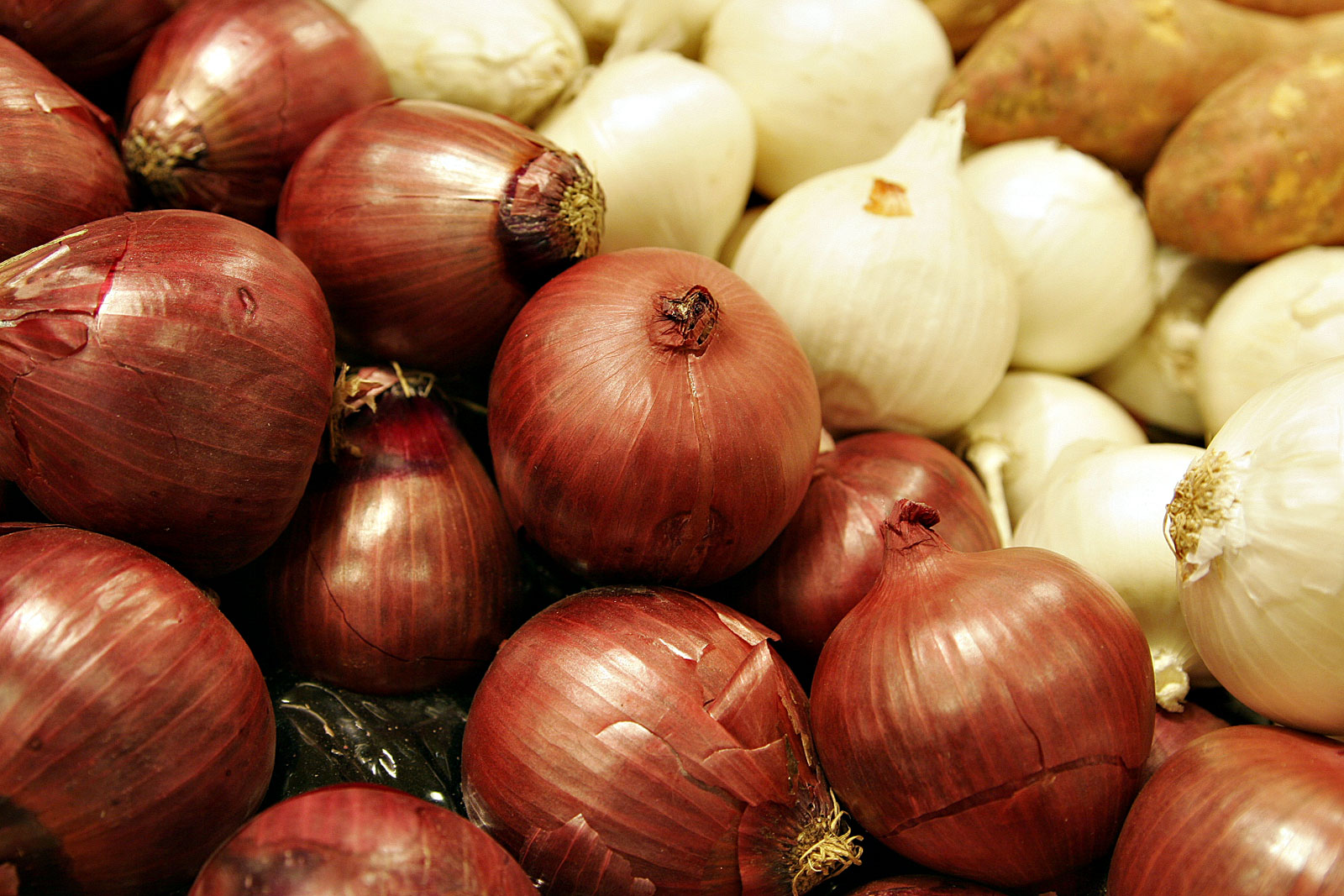
It can be assumed safely that the onion has contributed greatly to human diets for many a long year; indeed, there is strong evidence that, in the
Subscribe to:
Posts (Atom)
